SKU: 291084964
african spear plant 'sansevieria cylindrica

african spear plant 'sansevieria cylindrica 25

Sale price$19.13 Regular price$21.26
Save 10%

Pay in installments of $5.32 with ShopPay, AfterPay and Klarna

Shipping Estimate
USA
  • USA
  • CAN

Ships within 48 hours · Estimated delivery Aug 10 - Aug 15

Promo Codes Available:

For Your Every Summer RSVP, with Code: SUMMER15

Description

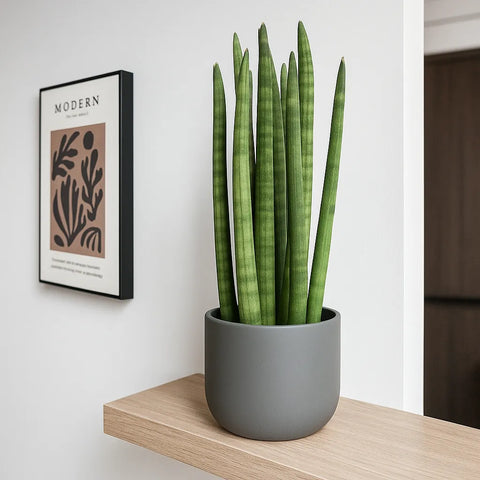
african spear plant 'sansevieria cylindrica 25Sansevieria cylindrica, commonly known as the African Spear Plant or Spear Sansevieria, is a striking and resilient succulent native to Angola. A member of the Asparagaceae family (previously Dracaenaceae), this species is celebrated for its sleek, cylindrical leaves that grow upright in elegant spears, radiating from a central crown. Each leaf is smooth, green grey, and subtly striped with darker bands, often tapering to a fine point. The leaves can

Sansevieria cylindrica, commonly known as the African Spear Plant or Spear Sansevieria, is a striking and resilient succulent native to Angola. A member of the Asparagaceae family (previously Dracaenaceae), this species is celebrated for its sleek, cylindrical leaves that grow upright in elegant spears, radiating from a central crown.

Each leaf is smooth, green-grey, and subtly striped with darker bands, often tapering to a fine point. The leaves can be grown upright in clusters, braided for a sculptural effect, or left to fan out naturally — making Sansevieria cylindrica a versatile choice for both minimalist and modern interiors.

Tough, drought-tolerant, and architectural, this plant is almost indestructible and thrives on neglect, making it ideal for busy households or offices. Its clean lines and muted tones complement any décor, while its air-purifying qualities add health benefits to its natural beauty.


Sansevieria cylindrica – Care Guide

Light

Tolerates a wide range of light conditions, from low light to bright, indirect light. It prefers bright conditions but adapts well to shaded areas. Can handle some direct sun but may develop pale patches if exposed for long periods.

Watering

Water sparingly. Allow the soil to dry out completely between waterings — Sansevieria cylindrica stores water in its thick leaves and is highly drought-resistant. In spring and summer, water every 2–3 weeks; in winter, reduce to once a month or less. Overwatering is the most common cause of issues.

Temperature and Humidity

Temperature: Thrives between 18–28 °C and tolerates occasional drops to 10 °C. Protect from frost and cold drafts.
Humidity: Prefers low to average indoor humidity and does not require misting. Perfect for dry indoor environments.

Soil and Potting

Use a well-draining cactus or succulent mix — a combination of compost, perlite, and coarse sand works well. A shallow, wide pot with drainage holes is best, as the plant’s roots grow horizontally. Repot only every 3–4 years or when it becomes root-bound.

Feeding

Feed every 6–8 weeks during spring and summer with a diluted cactus or succulent fertiliser. Avoid fertilising during autumn and winter when growth slows.

Pruning and Maintenance

Prune only to remove damaged or aged leaves near the base. Wipe the leaves with a damp cloth occasionally to remove dust and maintain their natural sheen. Rotate the plant occasionally for even light exposure and balanced growth.

Growth and Maturity

A slow-growing succulent, Sansevieria cylindrica typically reaches 60–100 cm in height. Mature plants may produce slender flower spikes with fragrant, tubular, greenish-white blooms, especially in bright light and well-drained soil.

Common Issues

  • Yellowing leaves: Overwatering or poor drainage.

  • Wrinkled leaves: Underwatering (time to give it a drink).

  • Soft, mushy stems: Root rot due to waterlogged soil.

  • Pests: Occasionally affected by mealybugs or spider mites — wipe with neem oil if necessary.


Background and Benefits

Native to Angola’s arid landscapes, Sansevieria cylindrica evolved to thrive in harsh, dry conditions with minimal water. Its cylindrical, succulent leaves are an adaptation for storing moisture, ensuring survival through prolonged droughts.

In addition to being one of the toughest indoor plants, it’s also an excellent air purifier — known to filter toxins such as formaldehyde, benzene, and xylene. Symbolically, Sansevierias represent resilience, strength, and endurance — traits that make this plant as meaningful as it is beautiful.


Quick Care Summary

  • Light: Low to bright, indirect light; tolerates some sun

  • Water: Allow soil to dry completely between waterings

  • Temperature: 18–28 °C; avoid below 10 °C

  • Humidity: Low to average; no misting required

  • Soil: Free-draining mix – cactus compost, perlite, coarse sand

  • Feed: Every 6–8 weeks in spring/summer

  • Growth: 60–100 cm tall; cylindrical green-grey leaves in upright or braided form

⚠️ Toxicity note: Mildly toxic to pets and humans if ingested; sap may cause mild mouth or skin irritation.


Styling Tip

Showcase Sansevieria cylindrica as a sculptural focal point in modern interiors. Its upright, minimalist form makes it ideal for desks, entryways, and living rooms. Pair it with neutral or textured planters — think terracotta, concrete, or matte ceramic — to complement its smooth, geometric structure. For a dramatic look, combine with other structural plants such as Zamioculcas ‘Raven’ or Ficus elastica ‘Robusta’. Perfect for low-maintenance décor, African Spear Plant brings both elegance and endurance to your indoor jungle.

Shipping Notes
  • Free Standard Shipping on $100+ Orders to the USA.
  • Except Preorder products are shipped in 48 hours.
  • Delivery to the USA:
  1. Standard Shipping : 3-10 business days
  • If time is of the essence, please consider selecting expedited delivery for faster service.
Exchange/Return Notes
  • We offer a 30-day return/exchange service after receiving.
  • Final sale items are not eligible for returns or exchanges.
  • To process your return/exchange, please contact us at [email protected]
  • Please click here for more details>>> Return & Exchange Policy
SKU: 291084964

Discover Niche Categories That Outsell african spear plant 'sansevieria cylindrica

Top-Converting Item to Boost Your Average Order

4.8 ★★★★★
Based on 20 reviews
Sort
Highest Rating
Newest First
Oldest First
Product Reviews
K
Verified Purchase
Kay Ennis
Waukegan, US
★★★★★ 5
Historical education, great book!
Format: Paperback
This is a very good book. It gives a very insightful culturally appropriate view toward understanding a viewpoint from another persons perspective!
WAS THIS REVIEW HELPFUL?YesReportShare
Reviewed in the United States on June 15, 2025
D
Verified Purchase
Dr VickersBey JD
Carnegie, US
★★★★★ 5
Post Traumatic Slave Syndrome
Format: Hardcover
Very well done book that does not make Black People feel angry nor White People guilty but from a gentle and skillful psychological point of view the book will "have you considered the impact of this or that upon both races as the result of Slavery in America?" A folk-like homespun way of tell these truths that masks the clinical questions that all trained psychologist asked..."and how would (does) that make you feel for all of us who ever sat on a couch?" The book made me consider the psychological impact of daily slave life with a WOW again and again as I never thought of the situations the book made me consider. The shared dehumanization of both whites and blacks due to the slave experience which goes a long way towards explaining to me why we as a country cannot truly discuss slavery's impact today. I found it self-healing and very necessary for all, both black and white, but especially for the victims of the African Holocaust my terminology not hers. I thought Dr. Leary PhD, did an excellent job and a high school or even a 6 grader could read the material without difficulty.
WAS THIS REVIEW HELPFUL?YesReportShare
Reviewed in the United States on November 18, 2010
H
Verified Purchase
Heather
Grantham, US
★★★★★ 5
Healing & Understanding
Format: Paperback
We are living in a slave master's land (was the Indians..). Hundreds of years of slavery, mental torture and degradation and then "freed." No therapy. No understanding, not even patience. To listen to Dr DeGruy's youtube videos was so enlightening to me. Sorrow, but understanding and then JOY. I didn't understand the anger, towards myself or others. Now, I can see where so much pain has come from. I can show compassion and love towards myself and others. Whatever programming I had, has been deleted--destroyed. I look back with pride, hurt, and know that I, myself, can heal. What a blessing this woman has brought us! Thank you Dr. Joy DeGruy!
WAS THIS REVIEW HELPFUL?YesReportShare
Reviewed in the United States on November 3, 2024
A
Verified Purchase
Athena
Alexandria, US
★★★★★ 5
Aged wisdom and knowledge
Format: Paperback
Mental health and history goes hand and hand
WAS THIS REVIEW HELPFUL?YesReportShare
Reviewed in the United States on June 22, 2025
A
Verified Purchase
A.
Louisville, US
★★★★★ 4
Why do black people . . .
Format: Hardcover
I purchased this book because I had many questions I wanted answered. Most of them were questions of "Why?". My biggest question was why we as black people have so many unhealthy habits in how we treat each other. As a young African American male who was raised by his mother in a predominantly white suburban area, I wanted to know why, when I encountered other black youth in more urban areas, they would tell me I "talk white." What is "talking white?" Basically, talking white means I was talking like I have an education. Why do so many members of the black community (those without an education) reject me for valuing education? Why is it that when one black person fidns a way out of the ghetto, it seems the whole neighborhood, church included, condems that person for leaving "his/her people" and wanting to live in the suburbs with the whites? Why don't we support one-another in this society that has always held us from achieving our full potential? I wanted to learn why we seem to have no clue of who we are, and so many of us, young and old, strive to "prove" we are "black enough." So talking a certain way makes us black? Or is it eating certain foods that makes us "black"? Listening to only certain kinds of music? We lack a firm sense of cultural identity. We take rebellious pride in being at the bottom, and equate success with "whiteness." We denounce the achievements of any black person and ostracize him from the community. We work to pressure our own to stay at the bottom. In this very interesting book, the author, Dr. Joy Degruy Leary, proposes a number of explanations for why the African American community has developed these and other unhealthy cultural habits. Leary examines this very real "crabs in the barrel" mentality, as well as many other self-destructive habits which plague the black community. Leary establishes a diagnoses, and calls it Post-Traumatic Slave Syndrome. Leary presents a very strong argument that the behaviors are all symptoms that have been passed down through the generations of African American people from the dawn of the trans-atlantic slave trade to today. Leary uses her own observations to support her theory of Post-Traumatic Slave Syndrome. This book is a very thoughtful read. The reason I give this work only four stars is because I truly feel that Leary's argument would have been much more affirmed and effective if she had included a visual timeline to help the reader to better understand the timeframes and chain of events in history discussed in the book. The argument also would have been more effective if the author spent more time on each point. At times it seems she's just getting started before summarizing all that was just said and moving on. Scholarly sources are cited and research is used, but the book does not explore any one study or statistic in great depth. It is a fast read.
WAS THIS REVIEW HELPFUL?YesReportShare
Reviewed in the United States on September 16, 2012

recommand products