SKU: 74054745467
sansevieria bacularis mikado

sansevieria bacularis mikado Fernwood Mikado

Sale price$25.38 Regular price$28.20
Save 10%

Pay in installments of $7.05 with ShopPay, AfterPay and Klarna

Shipping Estimate
USA
  • USA
  • CAN

Ships within 48 hours · Estimated delivery Aug 2 - Aug 7

Promo Codes Available:

For Your Every Summer RSVP, with Code: SUMMER15

Description

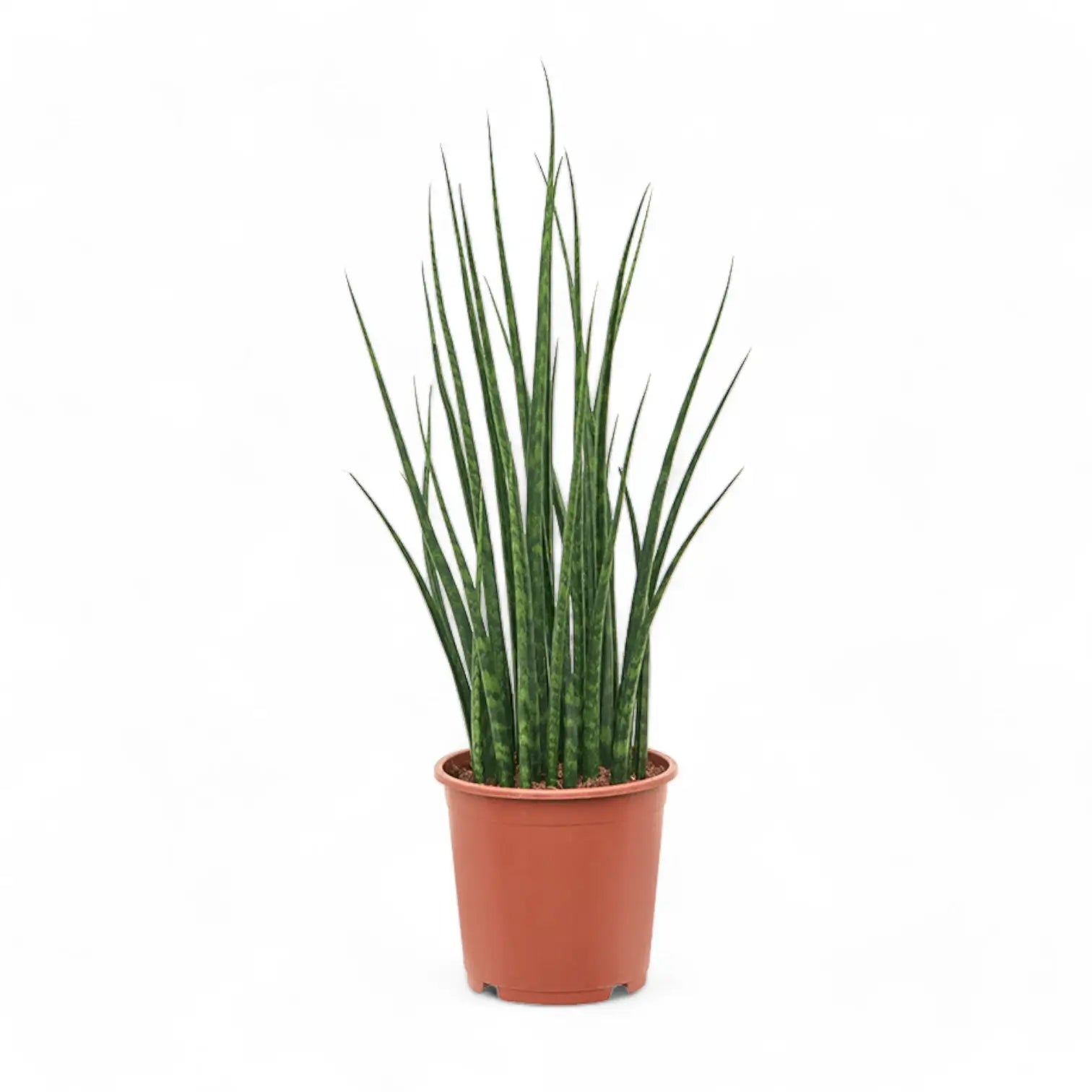
sansevieria bacularis mikado Fernwood MikadoDracaena (Sansevieria) bacularis 'Fernwood Mikado' Dracaena bacularis 'Fernwood Mikado' is a narrow, rod leaved snake plant with cylindrical foliage arranged in tight bundles. The leaves are slim, firm and almost spear like, with mid to dark green colouring and softer horizontal banding that becomes easier to see as the leaves mature. Young growth can emerge from darker, purplish basal sheaths before settling into the familiar green, stick like

Dracaena (Sansevieria) bacularis 'Fernwood Mikado'

Dracaena bacularis 'Fernwood Mikado' is a narrow, rod-leaved snake plant with cylindrical foliage arranged in tight bundles. The leaves are slim, firm and almost spear-like, with mid to dark green colouring and softer horizontal banding that becomes easier to see as the leaves mature. Young growth can emerge from darker, purplish basal sheaths before settling into the familiar green, stick-like outline.

This plant adds height, fine texture and a clear shape in a small pot. Its growth comes from a rhizome below the substrate, so new leaves appear from the base and slowly fill the container over time. In indoor culture, 'Fernwood Mikado' maintains a slim profile with vertical leaves that stay clear in simple pots and compact grouped pots.

Slender rod leaves in a tight bundle

  • Leaf shape: Thin, cylindrical leaves give the plant its distinctive stick-like silhouette.
  • Growth base: New shoots develop from the rhizome and gradually make the clump denser.
  • Colour pattern: Green leaves carry subtle lighter banding across the surface.
  • Container behaviour: It prefers a snug pot and usually needs repotting once the rhizomes have filled the space.
  • Flowering: Mature, settled plants may produce pale, fragrant flowers, though flowering indoors is occasional.

Rhizome growth and dry-season storage

Dracaena bacularis belongs to the group of rhizomatous, succulent Dracaena species long grown under the name Sansevieria. It stores water in firm cylindrical leaves and spreads slowly from an underground rhizome, while the roots perform best when the substrate dries between waterings.

The species is native to DR Congo, where it grows in a seasonally dry tropical biome. Indoors, Dracaena bacularis 'Fernwood Mikado' handles dry intervals well and develops steadily when the potting mix dries properly between waterings. Keep the plant warm, bright and protected from cold, wet conditions.

The narrow leaves can reach impressive height on mature plants, but indoor growth is usually slow and steady. New shoots often appear close together, giving younger plants a bundled look. As the clump develops, older leaves remain firm for a long time, while new leaves add height and density from the base.

Care for cylindrical leaves

  • Light: In bright indirect light, new growth stays firm and even. In lower light, the plant grows slowly and uses water at a gentler pace.
  • Watering: Let the potting mix dry deeply before watering again. In cooler months, extend the dry interval so the rhizome stays warm and aerated.
  • Substrate: Use a free-draining mix with mineral material such as pumice, lava rock, coarse sand or fine bark. The lower pot should drain quickly after watering.
  • Pot choice: A pot with drainage holes is essential. Cachepots are fine when excess water is emptied after watering.
  • Temperature: Keep it in normal indoor warmth, ideally around 15–24 °C. A warm root zone is especially important after watering.
  • Humidity: Average indoor humidity is enough. Normal room air is adequate for its dry-tolerant foliage.
  • Feeding: Feed lightly during active growth with a diluted cactus or balanced houseplant fertiliser. Slow succulent growth needs modest nutrition.
  • Repotting: Repot when the rhizomes have filled the pot or the substrate has broken down. A slightly snug pot helps the mix dry predictably.
  • Propagation: Divide established clumps when several shoots are present. Leaf cuttings can root slowly and take time to form a full plant.

Reading stress in a rod-leaved snake plant

  • Soft bases: Check the lowest part of the leaves, the rhizome and the moisture level in the pot. Soft tissue usually points to a wet root zone, especially in cool conditions.
  • Wrinkled leaves: Compare substrate dryness with root condition. Wrinkling can follow a long dry spell or root damage that limits water uptake.
  • Brown tips: Look for irregular watering, old knocks, mineral buildup or exposure to cold air. Trim only the dry tissue if the tip damage bothers you.
  • Slow growth: Check light first. Slow growth is normal, and a brighter position often improves new shoot production.
  • Leaning leaves: Rotate the pot occasionally and keep the plant stable. Mature cylindrical leaves can crack if they are forced back into position.

Leaf safety and placement

Dracaena bacularis 'Fernwood Mikado' belongs out of reach of pets and small children who may chew the firm leaves. Snake plants contain saponins, which can cause nausea, vomiting or diarrhoea in cats and dogs if ingested. A stable position also helps protect the tall leaves from snapping if the pot is knocked.

Botanical name and meaning

The accepted botanical name is Dracaena bacularis, while Sansevieria bacularis remains a widely recognised synonym in horticulture. The genus name Dracaena comes from the Greek drakaina, meaning “female dragon”, a reference historically associated with red resin in some dragon tree relatives. The species epithet bacularis comes from Latin baculum, meaning stick, rod or staff, matching the plant’s narrow cylindrical leaves.

Dracaena bacularis 'Fernwood Mikado' has narrow rod-like foliage, slow basal growth and a slim upright profile.

Shipping Notes
  • Free Standard Shipping on $100+ Orders to the USA.
  • Except Preorder products are shipped in 48 hours.
  • Delivery to the USA:
  1. Standard Shipping : 3-10 business days
  • If time is of the essence, please consider selecting expedited delivery for faster service.
Exchange/Return Notes
  • We offer a 30-day return/exchange service after receiving.
  • Final sale items are not eligible for returns or exchanges.
  • To process your return/exchange, please contact us at [email protected]
  • Please click here for more details>>> Return & Exchange Policy
SKU: 74054745467

Discover Niche Categories That Outsell sansevieria bacularis mikado

Top-Converting Item to Boost Your Average Order

4.2 ★★★★★
Based on 25 reviews
Sort
Highest Rating
Newest First
Oldest First
Product Reviews
D
Verified Purchase
Davut Habip
Whiting, US
★★★★★ 5
An amazing book ...
Format: Paperback
An amazing book. Reading the book helped me understand why the US is experiencing difficulties in "perceived righteousness" today. I would recommend it to anyone who would like to change the World for the better. Howard Zinn is a benevolent hacker: the kind of hacker I would like my children to be, and why not: all children to be. For me, Zinn’s A People’s History of the United States hacks history and defines a problem and offers a solution: 1. The problem: a one-sided patriotic history enslaves the masses, 2. The solution: a bottom-up, humanistic history empowers everyone and opens the doors for future reconciliations among different communities.(1) At this critical juncture of human history both are relevant not only for the US but rather for our race. A one-sided patriotic bias in history: at what cost? 1. hides wrongdoings and the associated guilt, 2. serves as the first line of defense to deflect current & future criticisms for the past & current mistakes, 3. tampers data gathering, silences questioning & divergence of opinions, 4. reduces communication among communities, 5. defines “the patriotic” and increases the chances of populating the armed forces, 6. defines the other: “the unpatriotic,” 7. increases insecurities, 8. evokes fears (of retribution, etc.) 9. can be misused to justify violence against “the other,” 10. builds a common memory for the masses, builds their egos so that these egos can later be exploited, 11. allows the word “culture” to be used as an equivalence: American culture = being American; (2) 12. a politician can mix these facts to incite emotional reactions of the masses and eventually reach a higher number of votes in a predetermined direction, inexpensively, 13. at school, in the media, in speeches of politicians, and during different rituals (starting with reciting the pledge of allegiance and singing of the national anthem) the patriotic history is repeated and reinforced. Under these conditions, the masses learn to repeat what is given to them. They shun away from questioning further. Their concept of free-will is replaced by a misplaced trust. They learn not to deviate from the norm: they are enslaved and are not even aware of this enslavement. Many words lose their meaning: “a more perfect Union” “Justice” “secure the Blessings of Liberty,” “democracy.” A higher degree of cynicism and later a deep feeling of helplessness ensue. There are costs to the individual, the family, the society. Since many worldwide look up to the US morally, the use of one-sided patriotic history in the US produces world leaders who imitate bad examples. Consequently, Humanity pays dearly. A bottom-up, humanistic history empowers everyone: 1. can eliminate ignorance, 2. can eliminate convenient forgetfulness, 3. can eliminate arrogance, 4. improve self-esteem, communication, & understanding 5. can reduce violence, 6. can empower the individuals and the masses: psychologically and economically and thus improve the quality of life, 7. can help the path to sustainable peace. Among the different communities, the wounds are real. A one-sided history often does not address all of these wounds. Denial freezes any possibility of a reconciliation. A reconciliation process would pass through an acceptance of a historical wrong doing. In time, mankind may realize that what Howard Zinn has started may be the building blocks of sustainable peace. As a new year starts, I wish upon all of us: nations, creeds, ethnicities, etc. our very own Howard Zinns. (1) In the US, these communities can be whites, blacks, American Indians, Mexicans, WASPS, Catholics, Jews, Moslems, Chinese, Japanese, etc. In Turkey, where I am from, these communities include the seculars, non-seculars, Alevites, Armenians, Greeks, Jews, Kurds, etc. (2) Most of us are led to believe that “being” American/WASP/Jewish/Moslem/... is a “culture;” we almost always have these attributes thanks to coincidences; i.e. we are born into these “states;” how can a state that is largely a coincidence, be culture? I would suggest that only what is done through our free-will is deemed culture. Interestingly worldwide, the education systems, the media, and politicians use and propagate the word “culture” to imply largely a static state, rather than the result of a willful action.
WAS THIS REVIEW HELPFUL?YesReportShare
Reviewed in the United States on December 24, 2016
L
Verified Purchase
Lyy
Phoenix, US
★★★★★ 5
Good quality
Format: School & Library Binding
Perfect!
WAS THIS REVIEW HELPFUL?YesReportShare
Reviewed in the United States on April 30, 2026
J
Verified Purchase
Jovana
Dallas, US
★★★★★ 5
Great book perfect for history lovers
Format: School & Library Binding
This book is perfect for people who love history in general. Very interesting topic in that it deserts why different cultures became more prominent than others over time. I’m still getting through it, but wanted to write a positive review because I’m enjoying it so much.
WAS THIS REVIEW HELPFUL?YesReportShare
Reviewed in the United States on January 23, 2024
B
Verified Purchase
Bella
Chelsea, US
★★★★★ 4
Makes you think!
Format: School & Library Binding
Jared Diamond’s Guns, Germs, and Steel is all about figuring out why some societies became super powerful while others didn’t. His main idea is that geography and the environment had a huge impact. Basically, places with good crops and animals to farm had an easier time growing and becoming stronger. The book mixes history, science, and geography in a way that’s pretty easy to follow, even though it covers a lot. Some people think Diamond focuses too much on geography and doesn’t consider enough other factors, but it definitely makes you think differently about history and why the world is the way it is today. It’s a really interesting read if you’re into learning about why things turned out the way they did.
WAS THIS REVIEW HELPFUL?YesReportShare
Reviewed in the United States on March 22, 2026
C
Verified Purchase
C Mong
Bozeman, US
★★★★★ 5
Great book
The narrator possesses a refined and compelling voice, and the author's writing style stimulates the mind. The author uses a tremendous amount of detail to avoid unnecessary/inaccurate generalizations and intentional/unintentional misinterpretations. However, the author executes this feat without allowing the reader to feel lost in mundane facts. I enjoyed the author's use of rhetorical questions to explore the viewpoints of persons who oppose his assertions. Overall, an informative and invigorating read. I highly recommend this book for anyone who has ever asked, "Why did certain people and cultures end up with so much, while others ended up with so little".
WAS THIS REVIEW HELPFUL?YesReportShare
Reviewed in the United States on August 26, 2010

recommand products