SKU: 93728199785
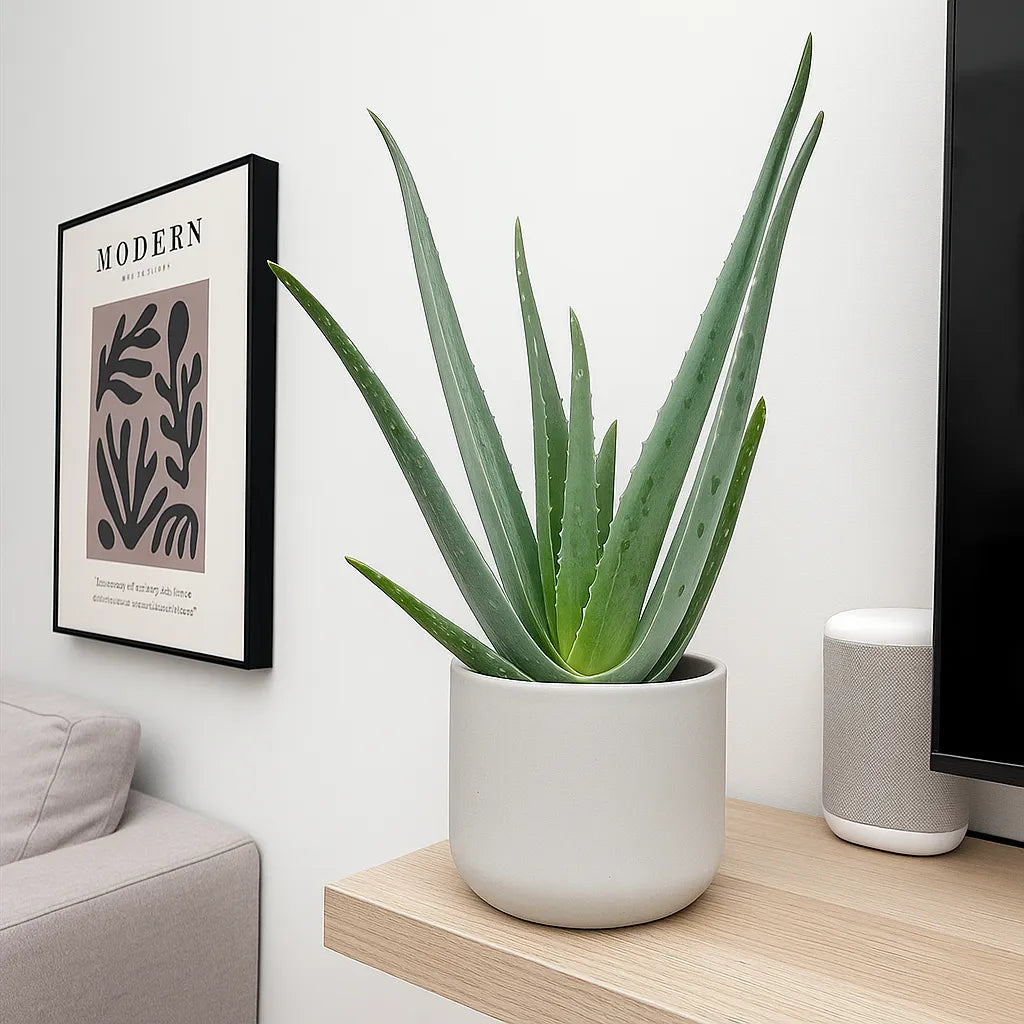
aloe vera potted plant

aloe vera potted plant 30

Sale price$21.16 Regular price$23.51
Save 10%

Pay in installments of $5.88 with ShopPay, AfterPay and Klarna

Shipping Estimate
USA
  • USA
  • CAN

Ships within 48 hours · Estimated delivery Aug 11 - Aug 16

Promo Codes Available:

For Your Every Summer RSVP, with Code: SUMMER15

Description

aloe vera potted plant 30Aloe vera is one of the most iconic and ancient succulents in cultivation, celebrated for both its striking architectural form and renowned healing properties. Belonging to the Asphodelaceae family and native to the arid regions of the Arabian Peninsula, this resilient plant has been cherished for centuries across cultures as a natural remedy, a symbol of health, and a timeless ornamental species. The plant forms a rosette of thick, fleshy, lance

Aloe vera is one of the most iconic and ancient succulents in cultivation, celebrated for both its striking architectural form and renowned healing properties. Belonging to the Asphodelaceae family and native to the arid regions of the Arabian Peninsula, this resilient plant has been cherished for centuries across cultures — as a natural remedy, a symbol of health, and a timeless ornamental species.

The plant forms a rosette of thick, fleshy, lance-shaped leaves in shades of green to blue-green, often speckled when young. The leaf edges are lined with soft, white serrations, giving the plant a sculptural, modern aesthetic. Inside each leaf is a clear, cooling gel packed with vitamins, minerals, and amino acids — long used in skincare and traditional medicine to soothe burns, moisturise skin, and promote healing.

When grown in ideal conditions, mature plants may produce tall, slender flower spikes bearing tubular yellow to orange blooms, adding a delicate vertical accent to their bold form.


Aloe vera – Care Guide

Light

Thrives in bright, indirect light to full sun. Indoors, position near a south- or west-facing window for maximum brightness. Outdoors, it enjoys full sun but benefits from light shade during the hottest part of the day. Insufficient light may cause leggy growth and pale leaves.

Watering

Water deeply but infrequently. Allow the soil to dry out completely between waterings. Overwatering is the most common cause of issues — Aloe vera stores water in its leaves and can tolerate drought far better than excess moisture. In winter, reduce watering to once every 3–4 weeks. Always ensure excellent drainage.

Temperature and Humidity

  • Temperature: Prefers 18–30°C. Can tolerate short dips to 10°C, but prolonged cold will damage the leaves.

  • Humidity: Adapts well to normal indoor humidity (30–50%). It prefers drier air and is well-suited to centrally heated homes.

Soil and Potting

Use a free-draining succulent or cactus mix, or combine compost with perlite and coarse sand. The roots must never sit in water. Terracotta pots are ideal for their breathability and moisture regulation. Repot every 2–3 years or when the plant becomes root-bound, ideally in spring.

Feeding

Feed sparingly — every 6–8 weeks during spring and summer with a diluted cactus or succulent fertiliser. Overfeeding can cause weak, watery growth. No feeding is necessary during autumn or winter.

Pruning and Maintenance

Remove any dried or damaged lower leaves by cutting them cleanly at the base. Wipe leaves occasionally to remove dust and maintain their healthy sheen. Older plants may produce offsets (“pups”), which can be separated and replanted once they develop roots.

Growth and Maturity

A slow to moderate grower, typically reaching 40–60 cm in height and spread indoors. Given enough space and light, it forms a graceful rosette that continues to expand with age. Mature plants may bloom annually under bright, warm conditions.

Common Issues

  • Yellowing or mushy leaves: Overwatering or poor drainage.

  • Brown tips: Underwatering or fluoride in tap water.

  • Pale leaves: Insufficient light.

  • Pests: Occasionally attracts mealybugs or scale; remove with a cotton swab dipped in rubbing alcohol.


Background and Benefits

Labeled “the plant of immortality” by the ancient Egyptians, Aloe vera has been used for over 6,000 years as a natural remedy for burns, skin conditions, and digestive health. Its inner gel contains vitamins A, C, E, and B12, antioxidants, and enzymes that promote healing and hydration.

Beyond its medicinal heritage, Aloe vera is one of the best air-purifying succulents, known to absorb formaldehyde and benzene from indoor air. It’s also incredibly low-maintenance, making it a perfect choice for both beginners and experienced collectors who appreciate functional beauty.


Quick Care Summary
Light: Bright light to full sun
Water: Allow soil to dry completely between watering
Temperature: 18–30°C; avoid below 10°C
Humidity: Low to average (30–50%)
Soil: Free-draining cactus/succulent mix – compost, sand, perlite
Feed: Every 6–8 weeks in spring/summer
Growth: Compact rosette, 40–60 cm; thick fleshy leaves with serrated edges

⚠️ Toxicity Note: While Aloe vera gel is safe for topical use, the latex layer beneath the leaf skin can be toxic if ingested, especially for pets. Keep out of reach of animals and children.

🌿 Styling Tip:
Display Aloe vera in a terracotta or stone planter to complement its desert aesthetic. It pairs beautifully with other drought-tolerant plants such as Sansevieria boncel ‘Variegata’ or Euphorbia trigona ‘Rubra’ for a sculptural, sun-loving arrangement that brings texture and tranquillity to bright indoor spaces.


    Shipping Notes
    • Free Standard Shipping on $100+ Orders to the USA.
    • Except Preorder products are shipped in 48 hours.
    • Delivery to the USA:
    1. Standard Shipping : 3-10 business days
    • If time is of the essence, please consider selecting expedited delivery for faster service.
    Exchange/Return Notes
    • We offer a 30-day return/exchange service after receiving.
    • Final sale items are not eligible for returns or exchanges.
    • To process your return/exchange, please contact us at [email protected]
    • Please click here for more details>>> Return & Exchange Policy
    SKU: 93728199785

    Discover Niche Categories That Outsell aloe vera potted plant

    Top-Converting Item to Boost Your Average Order

    4.2 ★★★★★
    Based on 25 reviews
    Sort
    Highest Rating
    Newest First
    Oldest First
    Product Reviews
    S
    Verified Purchase
    slimwriter
    Battle Creek, US
    ★★★★★ 2
    Not sour
    Not really sour at all so it’s a pretty disappointing candy.
    WAS THIS REVIEW HELPFUL?YesReportShare
    Reviewed in the United States on May 6, 2026
    M
    Verified Purchase
    Moon Riley
    New York, US
    ★★★★★ 5
    Sugar free
    Tastes great
    WAS THIS REVIEW HELPFUL?YesReportShare
    Reviewed in the United States on April 21, 2026
    M
    Verified Purchase
    Mr. Paul A. Ackermann
    Natrona Heights, US
    ★★★★★ 5
    Dude, it's not just a horror novel
    Format: Paperback
    This is to the previous reviewer (C. Scanlan). If this is just a horror novel, it failed miserably. It is not exactly a blood ’n gore thriller. Compared to Stephen King, it is pretty tame. What puts the horror in this book is that it is social commentary. Mary Shelly is not just trying to scare us. It is more than just a “Friday the 13th” movie. Mary Shelly is delivering a message. It seems that everyone understands this except this reviewer. There have been several different interpretations of the novel (see [...] for 10 different meanings of the novel). ICE takes the interpretation that Shelly is saying science can go too far. This is a perfectly valid interpretation. One can disagree with this interpretation but let’s not resort to name calling and personal attacks – that those who hold such an interpretation are doing a “low level attempt to cash in on home schooling Christian paranoia and fear of health care” or believe that “AIDS [is] the fruit of sin”. My wife and I are Catholic parents and we sent our children to public schools He mocks the idea of a secular fundamentalist but then demonstrates what that is. A religious fundamentalist sees anyone who disagrees with him as being of the devil. A secular fundamentalist sees anyone who disagrees with him as guilty of “brainwashing” others. In both cases, true dialogue is impossible. Another thing that a fundamentalist does is that he sees things in opposite extremes. If you are warning of the dangers of trusting too much in science then you must be against science. There is no middle ground for the fundamentalist. If you see that science can sometimes go too far then that means you are against health care. But this is a non-sequitur. Nielson writes “Frankenstein’s placing of the creation of life within the scientific method first destroys the unrepeatability and systematically eliminates the other elements [of hope, love, beauty, creativity and sacrifice]”. Nielson is not criticizing the scientific method in total. He is only criticizing it in the creation of life. The reviewer writes “He thereby easily and explicitly condemns the whole process and philosophy of the scientific method”. But Nielson is not condemning the whole process of the scientific method. He is only condemning it in the creation of life. The reviewer then mocks the credentials of the critics in the book - “So who are these essayists superior to Norton's and Oxfords and free of deconstructionist feminist secular fundamentalism, experts so august Ignatius should want them mentioned on their product page yet are nowhere to be seen?” But this game can be played both ways. What are the credentials of this reviewer? Is this reviewer so august as to challenge these essayists? Again, this is merely an ad-hominem attack. I really do not care who has the best credentials. What matters is who makes sense. Sometimes intellectuals can make the dumbest claims. Read Paul Johnson’s book, “Intellectuals” (http://www.amazon.com/Intellectuals-Marx-Tolstoy-Sartre-Chomsky/dp/0061253170/ref=sr_1_1?ie=UTF8&qid=1421862888&sr=8-1&keywords=intellectuals). He compares the essayists unfavorably to “good solid Roman Catholic moral theology” from the likes of Richard A. McCormick S.J., who “is the renowned leader of Roman Catholic Moral Theology in the field of bioethics in the USA.” He overlooks the fact that A. McCormick S.J. has dissented from teachings of the Popes Paul VI, John Paul II, and Benedict XVI over contraception. The “renowned leader” in the Catholic Church in morality is first and foremost the pope. Since Richard A. McCormick has contradicted the popes, he cannot be a good solid Catholic theologian. Mary Shelly lived right after the Enlightenment – man is the measure of all things. She lived at a time when people believed that science will solve all our problems. This is called scientism. ICE contends that Shelly is saying that we may be expecting too much from science. It does not mean that Shelly was saying that we should reject science. And it does not mean that Shelly believes that we should go back to the Catholic faith. In fact, ICE acknowledges that Shelly was an anti-Catholic. But the Church believes that the kernel of truth can be found in others, even in anti-Catholics. This is part of the Catholic tradition. St Augustine learned from Plato and St Aquinas learned from Aristotle. ICE would take that kernel of truth and expound that with the fullness of the Catholic faith. You may disagree with the Catholic faith, or with ICE looking at Shelly’s book from a Catholic perspective. But this is at least as a legitimate an interpretation as any other. In fact, this interpretation seems closer to the truth than the others. This interpretation is the traditional interpretation, which means that it goes back further to Shelly’s time than the modern interpretations, and is therefore less likely to be in error. BTW, the reviewer wrote that “Opus Dei right wing publishing (or reprint) house is selling this novel is to milk the home school market and to support its own bizarre bio-ethical ideology”. This is factually wrong. The company that publishes Opus Dei’s books is Sceptre. But the publisher of ICE is Ignatius Press.
    WAS THIS REVIEW HELPFUL?YesReportShare
    Reviewed in the United States on January 22, 2015
    R
    Verified Purchase
    RC Mom
    Lowell, US
    ★★★★★ 5
    Good experience
    Format: Paperback
    It was all good.
    WAS THIS REVIEW HELPFUL?YesReportShare
    Reviewed in the United States on November 24, 2025
    B
    Verified Purchase
    Brian J. Buckley
    Houston, US
    ★★★★★ 4
    Love the Edition and Footnotes; Don't need the Cultural Criticisms
    Format: Paperback
    The layout of the book and the footnotes are each great. What mars the book, unfortunately, is the editor's need to make simplistic statements about cultural elements. Several times, for example, he addresses "feminism," even using the term "Franken-feminists" in a puerile manner at one point. As too many of these conservative Catholics do, he simplifies and comments about modern culture without nuance. In this case, it is simply unprofessional and inaccurate (i) to not capture the myriad differences in feminist thought (many of which he and his readers would accept) and (ii) thereby to make all feminists the same (e.g,, assuming the feminists of the 1970's are the same as today's.) This is all unfortunate because when he is just addressing the literary elements of the book, his comments are wonderful and helpful to the reader. Any reader should know that this presentation will be tilted in an unsophisticated and simplistic way toward a traditional Catholic view (a view that can indeed be defended well while still being careful and charitable to critics). With that caveat, he (or she) should still buy it and garner a good edition of the text.
    WAS THIS REVIEW HELPFUL?YesReportShare
    Reviewed in the United States on March 12, 2024

    recommand products